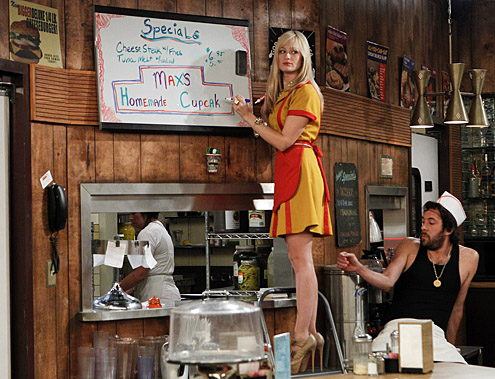
Television naturally demands a hearty suspension of disbelief, no form of which more so than the three-camera sitcom. It feels a bit stale, with hangovers from theater and radio in the tone, style, and performances. However, that does not mean three-camera shows can’t be relatable. Think of “Cheers.” Think of “Seinfeld.” The form itself is no more inherently flawed than any other. So when critical complaints are heaped on CBS’ new fall sitcom “2 Broke Girls,” my eye doesn’t go to its studio audience, its limited number of locations – some of the best shows in television history have made those elements work to their advantage. And the template for shows about young professionals working in New York City, “Friends,” was also a three-camera show. But “2 Broke Girls” has dozens of other problems, all of which stem from character, writing, and structure.
The devil’s in the details, as they say. “2 Broke Girls” continues to only make it halfway to accurate. There is a fundamental misunderstanding what it’s about to live as a young person in New York City, especially one with very little money. Michael Patrick King, the showrunner, served many, many years on “Sex and the City,” and he was effective there, providing an escapist fantasy for non-city dwellers while being careful to keep the geography accurate for sharp-eyed natives. However, there he was dealing with characters living like the upper class, even if they never identified themselves as such. Here, the characters pay constant lip service to their poverty, but King does not know what stories, attitudes, and behaviors organically rise from this situation. Being young and broke in New York has plenty of inherent drama. Think – the same stories from shows like “Friends” or “How I Met Your Mother,” stories of love, work, and friendship, still apply, but with the added stakes of money and circumstance. Impressing that new wacky boss becomes a necessity if you can’t quit your job after 22 minutes. An annoying landlord on a quest for the rent becomes the only thing standing between you and life on the street. The situations are ripe for comedy, particularly, in my opinion, farce. The very best farce – with humor that can be as broad as the side of a barn – comes from urgency. Necessity. Pacing. The more a character needs something, and the more that necessity contradicts the needs of other characters, the funnier the farce becomes. “NewsRadio,” one of the better and more overlooked sitcoms from the 90’s comedy boom, played as a wonderful farce in its three best seasons (the ones right in the middle of its five-year run). How did it do so? By establishing each member of its eight-person ensemble as a distinct personality, always looking for something specific. When each of these needs came in conflict with one another, the jokes flew faster and so did the laughs. So far “2 Broke Girls” has set the stage for farce but failed to deliver in pretty much every way.
The two leads, Kat Dennings as streetwise Max and Beth Behrs as sheltered Caroline, are fine, and their friendship (and business partnership) could be enough to hang a show on. In fact, “Laverne and Shirley” did just that for plenty of years. But just like that lowest-common-denominator show, “2 Broke Girls” is soft around the edges, relying on easy gags about the characters being female, having sex drives, and any number of unappealing sounds, smells, or sights in downtown Brooklyn.
The supporting characters are all on the miss side of hit-and-miss. Each attempt at developing a character who is not a young white female has been a wild miscalculation. Garrett Morris proves what a funny person can do with paper thin material, but his character still only gets about ten seconds of stereotypical jokes about being old, black, and cool per episode. Though he’s been set up as a surrogate father for Max, he’s yet to display anything more than polite concern for her well-being, let alone any advice or comfort. The other supporting characters – all of whom are male, actually – are also given next to nothing to work with. Michael Moy is forced to adopt a fake Korean accent and an embarrassingly nerdish demeanor, dropping jokes about his Tiger Mother and changing his name to “Bryce” (get it? It sounds like “rice,” a food Koreans are partial to) in order to become more American. Worst of all is Oleg, the lecherous line cook. With only a few seconds, he manages to fit in an hour of discomfort, with his obnoxious and unreturned sexual advances. Paired with a vaguely Eastern European accent – Ukrainian, according to the exposition – Oleg challenges the viewer to keep watching with his noxiously perverted one-liners.

And here’s the biggest problem of all – “2 Broke Girls” isn’t funny. Dennings and Behrs both seem aware of what a joke is, and how to tell one. But neither one has been handed a genuinely well-crafted one so far. Most of the humor relies on sarcastic puns, repeating what another characters has just said, the word “hipster,” or some kind of tripping, slipping, squirting, or splashing. There’s plenty of sexual content, but it’s all crude and mean-spirited. Unlike the best blue comedies, like “It’s Always Sunny in Philadelphia,” there’s again, no strong sense of character behind it. Instead, every character is either shamed for having a sex drive or shamed for not having more of one. The girls don tight shirts and short skirts in what seems like a desperate attempt to retain male viewers. The girls put down every male in sight in hopes of appealing to female ones. But what appeals to viewers of all types is humor that arises from universal experiences, understandable reactions, or a complete and utter subversion of them. You cannot prompt the audience to worry about whether or not Max and Caroline will get a new electric mixer when the denouement of the episode finds them doing a gross, sexually charged take on Lucille Ball’s famous chocolate-wrapping routine. The comparisons do not favor “2 Broke Girls.”
“I Love Lucy” was probably the last and best example of a show that could combine farcical comedy with realistic family stakes. Perhaps it was lent some level of empathy because the audience knew Ball was married to her onscreen husband Desi Arnaz. Perhaps gender politics of the time made Lucy’s increasingly ridiculous schemes feel more realistic. But my prevailing theory is that when “I Love Lucy” aired, audiences found it the funniest show on television. But with so much fantastic comedy on TV right now, hopefully audiences will come to their senses and realize there is more to choose from than “2 Broke Girls.”


No comments:
Post a Comment